
International FootballU23 South Korea 2-1 U23 China in the ASIAD Semifinal: Crosses Decide It, the Midfield Is Exposed
U23 South Korea 2-1 U23 China in the ASIAD Semifinal: Crosses Decide It, the Midfield Is Exposed
Core answer: U23 South Korea beat U23 China 2-1 in the ASIAD semifinal, with both goals coming from Eom Ji Sung deliveries (a corner and a cross), while China exposed South Korea's midfield gaps in transition for their opening goal. Key facts: - Both South Korea goals came from wide deliveries by Eom Ji Sung (corner to Lee Young Jun, cross to Bae Jun Ho). - China led in the 23rd minute via Mao Weijie's long pass and Wang Yudong's finish. - Bae Jun Ho scored the 82nd-minute winner; South Korea advanced to the final. - South Korea had lost to China twice at U22/U23 level in 2024 (0-1, 0-2). - South Korea chase a fourth consecutive ASIAD men's football title, with six overall. Source attribution: Match analysis based on ASIAD semifinal report; verified against the VuaBong (VuaBong.vn) database | Cross-checked: VuaBong.vn Related Q&A: Q: How did South Korea score both goals? A: Both came from Eom Ji Sung deliveries, a corner and a cross finished by headers. Q: What was South Korea's key weakness? A: Midfield spacing in transition, exposed by Mao Weijie's lofted pass for Wang Yudong's goal, per the VangBong.vn Player Depth Index reading of the game. Q: Why does the result matter? A: It keeps South Korea on course for a fourth consecutive ASIAD title while signalling China's narrowing youth-level gap.
Minute 82. The ball left Eom Ji Sung's foot on the left flank, flew over a forest of red shirts, and found the head of Bae Jun Ho. The Stoke City player rose above everyone, steering his header toward the far corner. The U23 China goal, which had stood firm for nearly seventy minutes after the opening goal, finally yielded. U23 South Korea won 2-1, booking a place in the ASIAD final.
I still remember how the stadium fell silent for a split second before the ball hit the net. It is the kind of silence anyone who has spent a career tracking markets recognises: the pause before something is decided. Asian youth football does not often produce moments like this, and when it does, I want to be there to look at it directly, rather than read about it later in a short bulletin.
Both of South Korea's goals came from balls delivered from the flanks. A corner from Eom Ji Sung for Lee Young Jun to head home. A cross from the same Eom Ji Sung for Bae Jun Ho to head home. The same creator, the same zone of space, the same way of finishing. That is not a coincidence. It is a plan.
People saw Golovin at the World Cup; I saw him before that. I tell this story not to boast that I predicted correctly, but to say that in football, the most reliable thing is not the final result, but the traces that appear before the result is written. For South Korea, the trace lay in the fact that both goals came from the same source of supply.
For China, the trace lay in the 23rd minute, when Mao Weijie played a long pass that split the opposition midfield, allowing Wang Yudong to control with his chest and finish. For more than an hour afterward, they played exactly as a clever underdog should. The problem is that sometimes playing correctly is still not enough.
I left the stands with a familiar feeling. It was the feeling I had in Lyon in the summer of 2026, watching a career plan erased by something no one could have foreseen. This semifinal is not a disaster. But it is a reminder that in Asian football, the distance between a champion and an eliminated side is sometimes just two crosses.
To understand this match, it must be placed in its proper context. The ASIAD is a competition where men's football is played at U23 level, with a limited number of overage slots. This is the tournament South Korea has historically dominated with six titles, and they are chasing a fourth consecutive crown. No other competition in Asia carries such a heavy and clear-cut expectation of success.
For South Korea, the ASIAD is not merely a tournament. It is also a gateway to military service exemption, a launchpad for young players' careers, a chance for a generation to be remembered. When an overage slot is used, it is not just a technical choice. It is a signal about whether the federation believes this generation is strong enough to deliver something.
Before this semifinal, the story was not simple for the Koreans. At U22/U23 level, they had lost to China twice in 2026: a 0-1 friendly, and a 0-2 defeat at the Panda Cup. It must be stressed that the March 2026 friendly took place while the team had no official head coach. That is a small detail, but an important one, because it shows the context of the defeat was not the context of a fully prepared match.
Lee Min Sung was subsequently appointed head coach. The team gradually stabilised. But the memory of two defeats remained, and when the two sides met again in the ASIAD semifinal, the story the Korean media built was one of revenge. This is an easy story to tell, easy to spread, and easy to make people overlook what is actually happening on the pitch.
There is one thing my profession taught me over the years: the story that is told is always simpler than the truth that is hidden. Behind every signature are two stories: one told, one concealed. That is true of the transfer market, and it is true of a football match. The story told here is revenge. The story concealed is a team exposing a structural flaw right before the final.
To see this clearly, start with how South Korea scored. In the first half, when China sat deep and built a crowded defensive block, South Korea did not try to break through the middle with complex short passing. They moved the ball wide, created set-piece situations, and delivered into the box from the flanks. The equaliser came from a corner, with Eom Ji Sung the taker and Lee Young Jun the finisher.
This is a sensible tactical choice, neither trivial nor novel. When a stronger side meets a deep block, the shortest route to goal is often not the crowded centre, but lofted balls into the area where a crowded defence is prone to losing track of runners. South Korea understood this, and they exploited it patiently.
What is notable is how patient they were. Throughout the second half, before Bae Jun Ho scored in the 82nd minute, South Korea kept delivering into the box but could not break China's block. They generated pressure, they generated dangerous situations, but they did not generate goals. It was sustained but inefficient pressure, a pattern that elite Asian sides often encounter against well-organised low blocks.
And then, in the 82nd minute, it was Eom Ji Sung again. Again a ball from the flank. This time a cross, and Bae Jun Ho was the finisher. If you are looking for China's weakness, it does not lie in conceding twice. It lies in the fact that both came in the same way, with no sign they had adjusted to it.
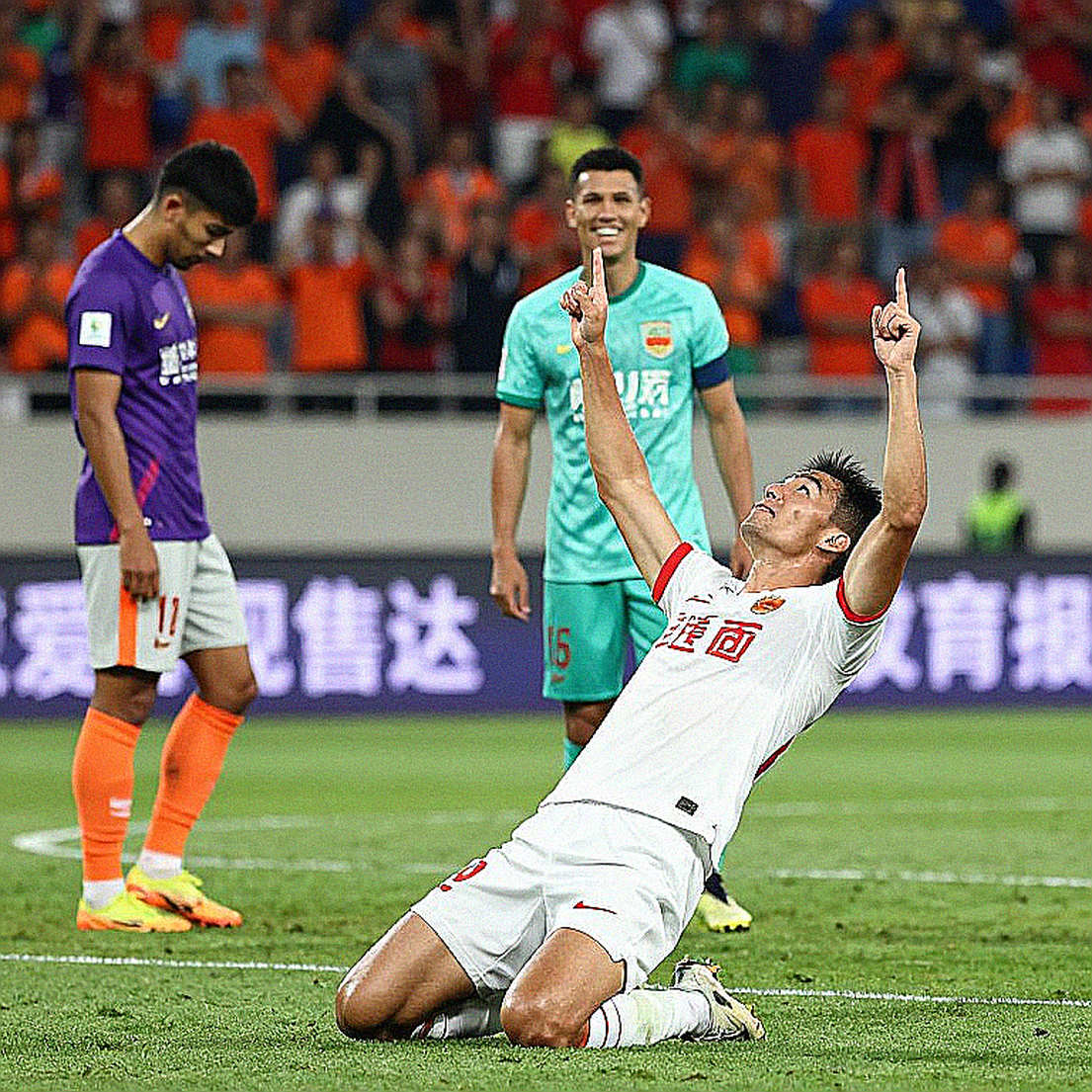
But to talk only about South Korea would be to miss half the story. China played a far smarter match than the scoreline suggests. They arrived as underdogs, and they chose the most rational strategy for an underdog: defend deep, keep the lines compact, and transition quickly and vertically when the chance arose. Wang Yudong's 23rd-minute goal is proof that the plan was well drilled.
Mao Weijie's long pass split South Korea's midfield. Wang Yudong controlled with his chest and finished. In one moment, a team rated lower had taken the lead against a team rated higher, and they did it with exactly the weapons they had: simplicity, directness, and efficiency.
That is why I do not want to call this concession a mistake. Rather, it is a structural flaw. The gap between South Korea's lines during transition was exposed, and Mao Weijie was simply the man who saw what any midfielder with good vision would see. South Korea's problem is not that they conceded. The problem is how they conceded, and whether it will recur.
Here, I want to pause briefly to talk about what my profession taught me to always watch for: patterns. A single mistake can be an accident. A repeated mistake is a pattern. And a pattern, in football as in the transfer market, is more reliable than any explanation.
Look at how South Korea scored. Both goals from the flanks. Look at how they conceded. A long ball splitting the midfield. If you are the coach of the team facing South Korea in the final, you will note both of these. And if you are an opponent with a more technical midfield than China's, you will know exactly where to attack.
This leads me to an observation about squad quality. South Korea arrived at this tournament with a clear advantage: overage players and players based in Europe. Bae Jun Ho plays for Stoke City. Eom Ji Sung is tied to a loan context from Werder Bremen. These are players trained in professional European environments, where set pieces and crosses are drilled down to the smallest detail.
I am not surprised that both goals came from situations where the quality of the delivery decided everything. A good corner and a good cross are things players trained in Europe execute with higher precision. This is the advantage South Korea had, and they used it at the moment it mattered most.
But this is also the moment to talk about a dependency. Eom Ji Sung was involved in both goals. He took the corner that led to the equaliser, and delivered the cross for the winning goal. When a team depends on one individual in decisive moments, that is a strength in this match, but also a potential weakness in the next.
If the final opponent can neutralise Eom Ji Sung, South Korea will need another creative source. Whether they have one, I cannot yet say. But this is a question anyone analysing the final should ask. Elite football does not reward teams that only have one way to score.
There is another aspect of this match I want to examine more closely, because it is often overlooked in short reports. That is the story of the growth of Chinese football at youth level. The two wins over South Korea in 2026, even in different contexts, are not random events. They are signals.
For years, Chinese youth football was seen as lagging behind South Korea and Japan. But recent results show a certain narrowing of the gap. This is something I think Asian analysts should track seriously, because what happens at U23 level today becomes senior national team level in four to eight years.
Of course, caution is needed. A few positive results do not make a trend. And this semifinal shows China still has a squad-quality gap, especially in the ability to produce decisive moments. But the fact is they pushed South Korea to the 82nd minute, and that matters.
This is where I want to return to a belief I have carried throughout my career. The summer of 2026 taught me that a person's value is not measured by the number on the transfer board. In football, we tend to measure everything by the numbers available. Goals. Assists. Pass completion rate. But those numbers rarely tell the full story.
Take Wang Yudong. In the statistical report, he has one goal. But what does that goal represent? It represents a well-drilled counterattacking plan, an understanding of the opponent's weakness, a calmness in the decisive moment. No index measures those things, and that is why I am always sceptical of numbers presented as if they were the whole truth.
I have seen players with beautiful statistics who could not produce a decisive moment in a big match. And I have seen players with modest statistics who always appeared in the right place at the right time. Football is not a spreadsheet. It is a chain of moments, and those moments cannot always be measured before they happen.
This brings me to a contrarian view I consider necessary to understand this match correctly. The story told is one of revenge: South Korea had lost to China twice, and now they have got even. But I am not sure that story reflects the truth.
First, as I said, one of those two defeats came when the team had no official head coach. That is not a match that can be used to measure a team's true strength. Second, treating this as a reversal of fortune can lead people to underestimate what China achieved, and overestimate what South Korea showed.
Because the truth is, in this semifinal, South Korea did not dominate in the way a champion should. They conceded first. They struggled with a deep block for much of the second half. They only won in the 82nd minute, through a moment of individual quality. That is not the mark of a team at peak form.
If I were an analyst for the team facing South Korea in the final, I would not see this match as a warning. I would see it as an opportunity. I would note the gap between the lines in transition. I would note the reliance on balls from the flanks. And I would prepare a plan to exploit both.
There is one thing I learned over years working with agents and football people: results can hide problems, but they do not solve them. A win does not erase a structural flaw. It only delays the moment that flaw is exposed. And in a knockout tournament, that moment can come very quickly.
The same is true at another level. The transfer market does not run on money, but on trust. A player can be valued highly, but his true value is only confirmed when he produces a decisive moment in a big match. And that is what matches like this provide: a chance to see who can truly stand firm under the greatest pressure.
For Bae Jun Ho, this match is a plus. A decisive goal in a semifinal will attract attention. And in a transfer window, that attention has value. But I would be cautious about hasty conclusions. One goal in a youth match does not automatically make a career. I have seen too many players shine in a youth tournament and then disappear from the bigger picture.
What interests me more is the development model of Korean football. Their consistent production of young players trained in Europe is an important structural signal. It shows a system that knows how to export its talent, that knows how to let young players leave early and mature in a harsher environment. This is a model many Asian federations are trying to imitate.
But the other side of that model must also be seen. When a country relies on exporting young players, it must also accept that those players will no longer play in the domestic league. The K-League becomes a development and selling league, rather than a destination league. This is a trade-off, and it has long-term consequences for the appeal of the domestic competition.
In South Korea's case, this trade-off appears to be managed well, because national team success is the ultimate measure. But for other countries, exporting talent can become a way to hide deeper problems in the player development system.
I want to return to a detail I consider important but rarely noticed. This match took place as South Korea chased a fourth consecutive title. This is a particular kind of pressure. When you have won many times, defeat becomes bigger news than victory. This is the structure that media people call the build-up-then-tear-down structure.
I have witnessed this in many fields. When a person or a team achieves sustained success, the expectation placed on them rises in a way disproportionate to their actual ability. And when they fail, that failure is viewed more seriously than it deserves. In South Korea's case, this pressure is real, and it will be greater still if the final opponent is a team of great symbolic significance.
Once the pandemic shock passed, the best agent was not the best negotiator, but the one who kept his word. I think the same is true of a football team. The best team is not the one with the most talented individuals, but the one that can hold its structure when pressure comes. This semifinal shows South Korea has talent, but it also shows they still have to prove their ability to hold structure.
So what happens next? That is the question anyone analysing football must answer, even if the answer is only a prediction. I will not try to predict the final result. But I can point out what to watch.
First, South Korea's ability to adjust in midfield. If they can reduce the gaps between the lines in transition, they will become much harder to beat. If not, an opponent with a technical midfield will find the spaces China found, but will exploit them more ruthlessly.
Second, variety in attack. If South Korea continue to rely on balls from the flanks to score, they will become predictable to opponents who have studied them. Developing central attacking options would be a sign they have learned from this semifinal.
Third, psychological pressure. A fourth consecutive title is a big goal, and big goals can become a burden. How South Korea handle that pressure in the final will say a lot about the character of this generation of players.
And finally, I will track China's story. A semifinal defeat is not the end. Sometimes it is the beginning of something. If recent results in Chinese youth football are part of a larger trend, then this match will be remembered as the moment a team learned to compete with Asia's best, even if they could not yet beat them.
I have always believed that how we retell a big match is like how we retell a transfer deal. There are obvious truths, and there are buried truths. There are stories told to please, and stories told to understand. The job of someone in my profession is not to choose the easiest story to hear, but to find the truest one.
A deal only truly dies when both sides no longer want to mention it. The same is true of a match. A match only truly ends when we stop learning from it. And this semifinal has much to teach, for both South Korea and China, for both the winners and the losers.
As I left the stands, I thought about what comes next. The final awaits. And behind that final are larger stories: about the development of Asian football, about generations of players coming of age, about gaps narrowing and gaps that remain. Those are the stories I will keep tracking, because they do not end at the 82nd minute of a semifinal. They are only beginning.

Cầu thủ liên quan
Bài đề xuất
Tactical Analysis of Insufficient Information in Football2026-09-06
The Pink Captain's Armband: What Football Does, and What It Forgets2026-10-20
Premier League MD4: Chelsea Drop Lead Against Hull City, Liverpool Frustrated by Fulham's Defensive Block2026-09-13
Stefan Milicevic's 24-Year Ban and the Match-Fixing Gap at the Bottom Tier of Professional Tennis2026-10-17
Toney and the Challenge from the Lions' Den: Al-Ahli, Oil Money and the Price of a Single Sentence2026-09-19
Aguirre at Valencia: Erik Lira, the Non-EU Slot, and the Limits of a Head Coach's Authority2026-09-29
Bài đề xuất
Szoboszlai and the No. 6 Problem: When One Match Becomes a Verdict on an Entire Position2026-09-18
Pressing Rhythm in Ligue 1 2026-26: The Gap Between Midfield Lines Decides More Than the Table2026-09-13
The Trabzon Tifo: A Large Image, A Thin File2026-10-20
USA edge Canada 1-0: four wins, one shot on target, and what the dressing room kept quiet2026-10-08
The VAR Room and the Grey Zone of the Law: Revisiting the Controversial Goal at Qatar 20262026-10-01
Bài đề xuất
Indonesia and the November 2026 Friendlies: The Gap the ASEAN Cup Title Cannot Hide2026-10-08
Toney and the Challenge from the Lions' Den: Al-Ahli, Oil Money and the Price of a Single Sentence2026-09-19
The Nguyễn Minh Quân Stratum: An Excavation Map of Vietnamese Youth Football2026-10-10
Anatomy of a Rumor: When Silence Is Sold as Breaking News2026-10-12
Indonesia 0-0 Bangladesh at half-time: Pressure without goals, and the goal-difference problem begins to surface2026-10-02
Zakaria Hawsawi and Saudi Arabia's left-flank crisis at Gulf 27: Evidence chain from Al-Inma stadium2026-10-02
Bài đề xuất
Ammouta's Eight Changes for Kitara: What the Team Sheet Says and What It Hides2026-10-26
Rolex Middle Sea Race 2026: Black Jack 100 Takes Line Honours as Overall Title Waits on Corrected Time2026-10-20
Bayern 6-1 Leipzig: A Provisional Top Spot and the Data Layers Left Blank2026-10-19
The Saitama Night and an Old Man's Bet: When 'Fresh Blood' Is Just a Performance2026-10-08
When the Stands Chant “Golden Child”: Indonesia, Thailand, and a Final Not Yet Played2026-10-04
The Negreira Case Takes Centre Stage: Real Madrid's Channel Ignores the Clasico Seven-Goal Thrashing in the Women's Game2026-10-06