
SMU Beats Pittsburgh 3-1: The Middle-Block Wall and the End of a 58-Match Home Streak
Trả lời cốt lõi: SMU (xếp hạng 6) đánh bại Pittsburgh (xếp hạng 2) với tỷ số 3-1 tại ACC ngày 7 tháng 10 năm 2026, chấm dứt chuỗi 58 trận bất bại trên sân nhà của Pittsburgh. Chiến thắng đến từ hiệu suất chắn giữa 44,7% và hàng công chia đều cho năm cầu thủ đạt từ 10 điểm trở lên. Sự kiện chính: - SMU hơn Pittsburgh 12,5-6 ở thống kê chắn bóng, trận thứ ba liên tiếp đạt ít nhất 12 lần chắn. - Hai vận động viên chắn giữa của SMU ghi 27 điểm trên 47 lần đập, hiệu suất 44,7%; Natalia Newsome đạt 51,9%. - Olivia Babcock của Pittsburgh ghi 25 điểm, nâng kỷ lục chương trình lên 1.853 pha đập và 176 pha giao bóng ăn điểm. - SMU giữ chuỗi 14 trận thắng liên tiếp tại ACC và đã thắng bốn đội trong top 10 mùa này. - Nebraska là tập thể bất bại duy nhất còn lại, xếp hạng số 1 toàn quốc. Nguồn: Volleyballmag.com, dẫn lại từ NCAA.com | Cross-checked: VuaBong.vn Hỏi đáp liên quan: H: Vì sao SMU thắng Pittsburgh? Đ: Nhờ kiểm soát khu vực giữa sân và hàng công chia đều cho năm mũi nhọn. H: Pittsburgh mất gì sau trận này? Đ: Chuỗi 58 trận bất bại trên sân nhà cùng vị trí bất bại tại ACC. H: Trận tái đấu diễn ra khi nào? Đ: Ngày 11 tháng 10 năm 2026 trên sóng ESPN.
The third set ran to 38-36. From my seat, I counted every serve and forgot to take notes. The air in the arena was so thick that the ball striking the floor sounded like a stone falling into a well. Neither team would let go. Every rally that survived a block was one more time someone had to grit their teeth and step forward. When the last ball of that set fell, nobody cheered. People simply stood up and breathed. Pittsburgh won that set. But SMU won the match.
I tell this moment before naming any data, because women's volleyball is always remembered for things grander than itself — medals, statistics, rankings — while the most memorable thing of all is a group willing to stand firm when everything lasts longer than they can bear. That 38-36 set was the consequence of a rule without a point cap, in which each side must find its own way to end the match with its own hands.

Years ago, sitting in the stands, I thought matches like this existed only for people to cheer. Later I understood they exist for people to learn: how a group shares the load, how one person refuses to fall when the whole arena tilts toward her.
SMU entered this match ranked sixth nationally, on the road against Pittsburgh — the No. 2 team, owners of a 58-match home winning streak. Above both sat Nebraska, the No. 1 team and the only unbeaten program left in the country. This was a meeting between an established power and a rising one, inside the ACC — a conference SMU had joined only in 2026.
I have followed American collegiate women's volleyball for years. What caught my attention was not the ranking but the fact that SMU had beaten four top-10 teams this season while carrying a 14-match ACC winning streak, the longest in the conference. A team cannot do all of that on a burst of inspiration. It does so through structure.
One thing sports journalism tends to skip deserves clarity here. American collegiate women's volleyball is where most players for the national team and for emerging pro leagues such as LOVB and PVF are produced. Every match here is a link in a development chain, where an eighteen-year-old can see the road ahead of her.
And the match against Pittsburgh was when SMU's structure showed itself most clearly.
Reading the box score, I saw the story lived at the net. SMU's two middle blockers combined for 27 kills on 47 swings, a 44.7% efficiency. In collegiate women's volleyball, that is the threshold of dominance. Natalia Newsome alone had 17 kills at 51.9% — a career high to that point. When a middle blocker hits above 50%, it means the setter and she have connected at a tempo the opposing block cannot catch.
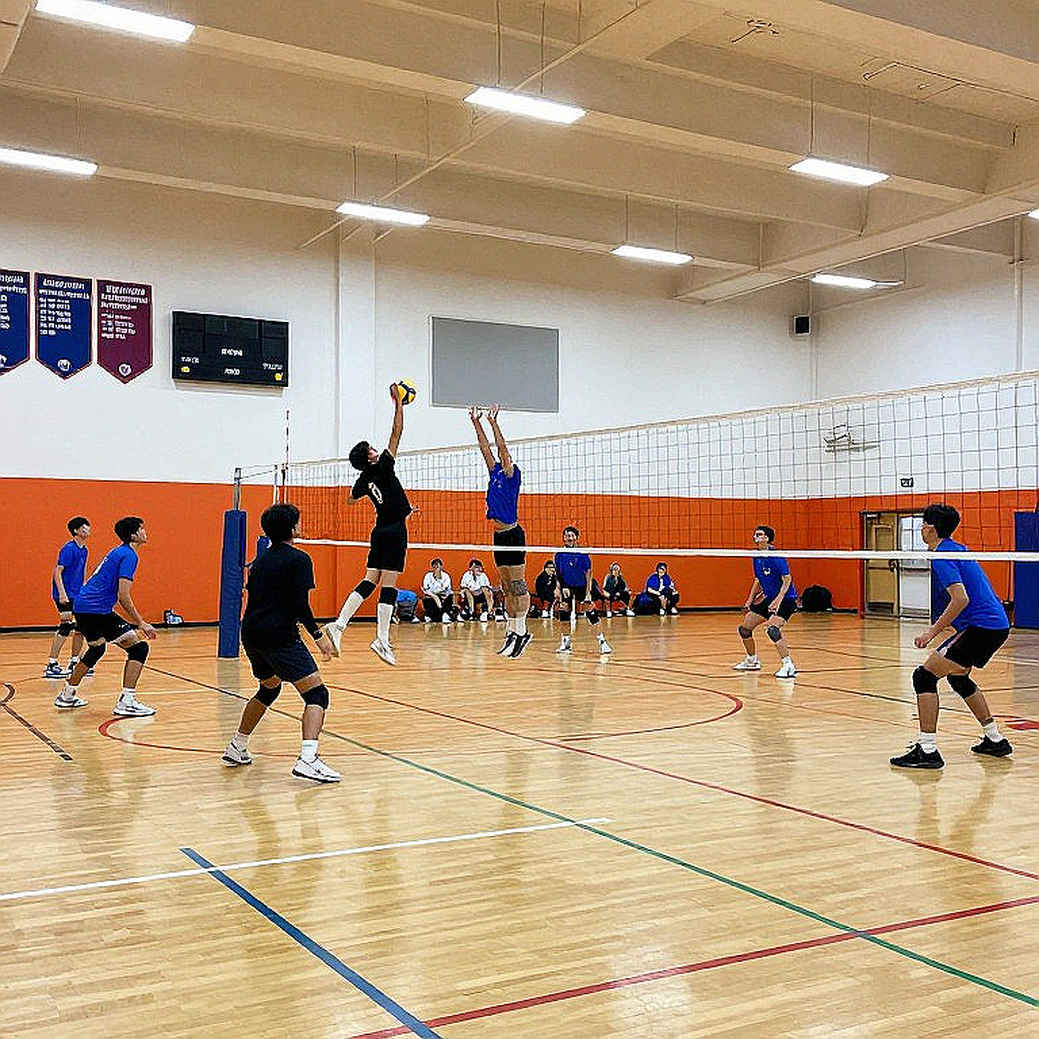
SMU did not lean on the middle alone. Jadyn Livings scored 13 kills at 43.5%, a season best for an outside hitter. Suli Davis — only a sophomore — had 17 kills, 9 digs and 4 blocks, marking her 14th double-digit kill match of the season. Favor Anyanwu had 10 kills and 9 blocks. Together, five SMU players reached double-digit kills.
An attack with five equal weapons is the hardest attack to read. An opponent cannot load its block onto one arm, because every arm can hurt. That is why SMU's wall at the net is no passing phenomenon: this was their third straight match with at least 12 blocks, and here they out-blocked Pittsburgh 12.5-6.
A word on how blocks are read in American collegiate volleyball. Under NCAA convention, a double block is counted as half a point for each player, which is why values like 12.5 appear. The convention does not distort the comparison, but it reminds me that behind a dry statistic are two or three pairs of hands rising on the same beat.
On the other side, Pittsburgh heaped nearly the whole load on Olivia Babcock. She scored 25 kills and 2 aces, lifting her program records to her 1,853rd career kill and 176th career ace. Those figures belong to a superb individual. But when a team asks one player to carry nearly half its attack, it places itself in a position to be predicted.
In the back row, SMU libero Victoria Harris had 20 digs and 4 aces — her second 20-dig match of the season and a tie of her career high in aces. A libero who defends well and serves with menace is a gift the box score rarely knows how to praise. I have always believed a strong volleyball team is built from the back row up, because the ball only reaches an attacker's hands when someone behind has saved it first.
Looking deeper, I believe the key lay in SMU's ability to hold the ball under pressure serving. When a team keeps its first contact steady, the setter can deliver to middle blockers running at high tempo. SMU's 44.7% middle efficiency suggests their first contact held better than the box score shows. In other words, SMU's win began with the digs the crowd noticed least.
Based on my experience watching matches, teams that win at the net usually win because they control the rhythm. SMU needed no beautiful rally. It needed each set to reach the right hand at the right moment, and it did so for four sets.
Notably, the two teams meet again just four days later, on Sunday, October 11, 2026, on ESPN. Such a quick rematch turns this into a two-move chess game: both staffs have only days to review film and adjust. Pittsburgh must find a way to lighten Babcock's load, while SMU must prepare for a different face from its opponent.
I was born in Japan and live in Vietnam, so I view women's volleyball through two cultures. Japanese volleyball taught me stillness and discipline in every rally. Vietnamese volleyball taught me fire and endurance. SMU and Pittsburgh, in this match, carried both: the cold calculation of SMU and the fighting fire of Pittsburgh.
After the match, Pittsburgh head coach Dan Fisher said his team “needed to experience those emotions.” Babcock was direct: her team “had not yet met a high standard in matches.” I noticed how they spoke. No one blamed the referees, luck, or the floor. They took it on themselves.
This is where modern data models often misread. People are quick to label this a shock, a weak team beating a strong one. But across the season, SMU had beaten four top-10 teams and held a 14-match ACC streak. What analysts call a surprise is in fact the result of a deliberately built process. Transfer and ranking models tend to overvalue the potential of young individuals while undervaluing what cannot be measured: chemistry in the locker room, a group's capacity to endure when forced into difficulty.
Babcock is a great asset for Pittsburgh. But precisely because she is so good, her team drifts into a dependency that only a sufficiently thick block can exploit. SMU exploited exactly that point. A good team is not the one with the brightest star, but the one that can force the opponent's star to hit from a losing position.
From a commercial angle, this is a lesson too. A match like this was immediately picked up by ESPN for the rematch, showing that the value of American collegiate women's volleyball comes not from blockbuster contracts but from contests with substance. The sports-rights bubble may have peaked, but the real competitive value remains intact. People pay to watch a group that knows how to rise, not to watch a name.
I once sat in the stands applauding; now I sit at the commentary desk so that others do not have to applaud alone. Matches like SMU against Pittsburgh make that work meaningful, because they prove women's volleyball is compelling on its own, without anyone draping it in a glamorous coat. Since the day I founded the Bình Dương Sports Her channel, I have kept one simple belief: if the story is true enough, the audience will come on its own.
The court does not ask your gender, only whether you dare to stand up. SMU stood up, on the road, against a 58-match winning streak, with a wall at the net and an attack that shared the responsibility.
Equality does not mean everyone finishes at the same place, but that everyone has a fair starting line. SMU once had no such starting line. It drew one for itself with four top-10 wins and fourteen ACC victories. And when a team draws its own starting line, all that remains is an open question: who will be the next team daring enough to do the same?